




A workplace injury puts you in an unfamiliar situation quickly. You are dealing with pain, uncertainty about your job, and a claims process you have probably never navigated before. The South Carolina workers’ compensation system is designed to cover medical treatment and lost wages when you are hurt on the job, but it comes with deadlines and procedural requirements that can affect your benefits if they are not met. Understanding the steps ahead of time makes the process less overwhelming and helps protect your claim from the start.
Report Your Injury to Your Employer First
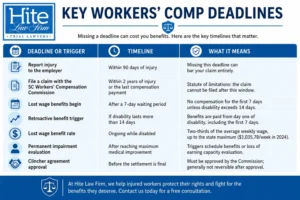
The first step after a workplace injury is reporting it to your employer. In South Carolina, you are required to notify your employer of a workplace injury within ninety days of the accident. Missing that window can put your entire claim at risk. The sooner you report, the better, both for your claim and for your medical care.
Your notice does not need to be formal. Telling your supervisor that you were injured and how it happened is sufficient. That said, putting it in writing creates a record. A text, an email, or a written incident report protects you if there is a later question about whether notice was given.
What Your Report Should Cover
- When and where the injury occurred
- How the injury happened
- What part of your body was affected
- Any witnesses who were present
Occupational diseases, including conditions caused by repeated exposure to hazards at work, have a different notice timeline. South Carolina law generally requires notice within ninety days of when you knew or should have known that the condition was work-related. If you are dealing with a gradual condition rather than a single incident, it is worth getting legal guidance on how the timeline applies to your situation.
Seek Medical Treatment Through the Right Channels
South Carolina workers’ compensation law gives your employer the right to select the authorized treating physician for your claim. Going to your own doctor first, without authorization, can create complications for your claim. Unless you have a medical emergency, the process typically starts with your employer directing you to an authorized provider.
If you have a true emergency, go to the nearest emergency room. Emergency treatment is covered. Document everything from that visit and notify your employer as soon as possible.
The authorized physician is your primary treating provider for the claim. You can request a second opinion in some circumstances, but the process for doing so is specific under South Carolina law, and departing from the authorized care path without following that process can affect your benefits. If you believe the authorized physician is not providing appropriate care, that is a situation where legal advice is worth seeking before you take action on your own.
Medical Benefits You Are Entitled to Under South Carolina Law
- All reasonable and necessary medical treatment related to your work injury
- Prescription medications for your work-related condition
- Physical therapy and rehabilitation services, when prescribed
- Mileage reimbursement for travel to authorized medical appointments
- Medical equipment and assistive devices, when prescribed by your treating physician

Understanding the Workers’ Compensation Claim Process in South Carolina
After you report your injury and begin treatment, your employer is required to file a First Report of Injury with the South Carolina Workers’ Compensation Commission. That filing initiates the formal workers’ compensation claim process. Your employer’s insurance carrier will then either accept or deny the claim.
If the claim is accepted, you will begin receiving benefits for authorized medical treatment and, if your injury prevents you from working, compensation for lost wages. South Carolina Workers’ Compensation Commission pays temporary total disability benefits at two-thirds of your average weekly wage, subject to a maximum set by the Commission. In 2024, that maximum was $1,035.78 per week.
The waiting period for lost wage benefits in South Carolina is seven days. If your disability lasts longer than fourteen days, you are entitled to benefits from the first day you missed work. That retroactive coverage for the first seven days is something many workers do not know about and sometimes do not receive without asking.
Key Deadlines in the South Carolina Workers’ Compensation Process
- Ninety days: deadline to notify your employer of a workplace injury
- Two years: statute of limitations to file a claim with the South Carolina Workers’ Compensation Commission after the date of injury or the date your employer last paid compensation
- Seven days: waiting period before lost wage benefits begin
- Fourteen days: if disability extends beyond this point, benefits are paid retroactively to day one
What Happens if Your Claim Is Denied
A denied workers’ compensation claim is not the end of the road. South Carolina law provides an appeals process, and many denials are successfully challenged. The Workers’ Compensation Commission has a formal hearing process where you can present evidence and testimony supporting your claim. A commissioner reviews the evidence and issues a decision. That decision can be appealed further if necessary.
Common reasons for denial include disputes over whether the injury was work-related, questions about whether proper notice was given, and disputes about the extent of the injury or required treatment. Each of these can be addressed with the right evidence and preparation.
The appeals process has its own deadlines. If your claim is denied, do not wait to seek guidance. The window to respond to a denial is limited, and missing it can waive your right to appeal.
Steps After a Denial
- Review the denial notice carefully to understand the stated reason
- Gather documentation that addresses the basis for the denial
- Request a hearing before the Workers’ Compensation Commission
- Consult with a workers’ compensation attorney before the hearing if you have not already
When Legal Representation Makes a Difference
Some workers’ compensation claims move through the system without significant complications. Many do not. Disputes over whether an injury is work-related, the extent of a disability, the medical treatment being provided, or the value of a settlement are all common reasons claims become more complex.
When those issues arise, legal guidance can make a meaningful difference. A workers’ compensation lawyer can help you navigate the claims process, meet important deadlines, gather supporting documentation, and advocate for the benefits you may be entitled to under South Carolina law.
According to a study by the Workers’ Compensation Research Institute, injured workers represented by attorneys receive significantly higher compensation than those who handle their claims without representation, even after fees are accounted for.

Permanent Disability and Settlement in South Carolina
If your work injury results in permanent impairment, you may be entitled to additional benefits beyond temporary disability payments and medical coverage. South Carolina determines those benefits differently depending on the type of injury:
- Scheduled injuries: Certain body parts, such as an arm, leg, hand, or foot, are assigned a maximum number of weeks of compensation based on the degree of permanent impairment.
- Non-scheduled injuries: Injuries such as those involving the back or those that affect your overall ability to earn a living are generally evaluated based on your loss of earning capacity rather than a fixed schedule.
Some workers’ compensation claims are resolved through a settlement agreement, known as a clincher agreement. Before agreeing to a settlement, it is important to understand that:
- A clincher typically closes out future medical and indemnity benefits related to your work injury.
- Once approved by the South Carolina Workers’ Compensation Commission, a clincher agreement is generally final.
- Accepting a settlement means giving up certain future rights, so understanding the terms before signing is essential.
Settling a claim can be the right decision in some situations, but it should be evaluated carefully with a full understanding of what the agreement includes and what benefits it may permanently close.
Protecting Your Claim Starts With Understanding the Process
No two workers’ compensation claims are exactly alike. The nature of the injury, the medical treatment required, how long recovery takes, and whether disputes arise all influence what the process looks like for each injured worker. What remains consistent is the importance of understanding your rights, meeting deadlines, and following the required steps from the beginning.
Most people are learning how the workers’ compensation system works while they are already dealing with an injury, missing work, and trying to recover. Taking the time to understand the claims process can help you avoid common mistakes, make more informed decisions, and better protect the benefits you may be entitled to. Whether your claim is straightforward or more complex, having a clear understanding of what to expect can make the process feel far less overwhelming.