



Nothing prepares you for the sudden loss of someone you love. The grief is overwhelming, the questions come fast, and somewhere in the middle of it all, someone tells you there may be legal steps to take and deadlines to meet. That is an enormous amount to carry.
If your loved one died because of someone else’s negligence, recklessness, or wrongful act, South Carolina law gives you the right to pursue justice. A wrongful death case will not undo what happened. What it can do is hold the responsible party accountable and provide financial relief when it is needed most.
Get Answers After the Loss of a Loved One
If someone else’s negligence or wrongdoing caused your loved one’s death, your family may have the right to pursue a wrongful death claim. Schedule a free consultation with Hite Law Firm to understand your legal options.
Discuss Your SituationWhat Is a Wrongful Death Case in South Carolina?
A wrongful death action is a civil lawsuit brought on behalf of a deceased person’s estate when their passing was caused by the negligent, reckless, or intentional act of another party. It is separate from any criminal case that may arise from the same incident. A criminal conviction is not required, and a civil judgment does not depend on criminal proceedings.

SC Code § 15-51-10 governs this type of action. It allows the personal representative of the deceased person’s estate to file a civil lawsuit against the responsible party or parties. The resulting recovery is distributed to the beneficiaries designated under state law, not to the estate itself.
Survivors sometimes wonder whether they need to wait for a criminal case to conclude before pursuing a civil action. The answer is no. A civil proceeding and a criminal prosecution are entirely separate. They can run simultaneously, and the outcome of one does not control the other. In a criminal case, the government must prove guilt beyond a reasonable doubt, the highest standard of proof in the legal system. In a civil case, the standard is preponderance of the evidence, a meaningfully lower bar. It is common for survivors to succeed in civil proceedings even when criminal charges were never brought, or when a criminal trial resulted in an acquittal. If a criminal conviction does exist, our attorneys evaluate how it can strengthen the civil case.
Who Can File a Wrongful Death Claim, and Who Receives the Recovery?
State law requires the personal representative of the estate to file the action. This is typically the executor named in the will. If there is no will, the probate court appoints an administrator. Either way, the representative acts on behalf of the surviving loved ones. Our attorneys handle both wrongful death actions and probate matters, so we can advise the representative and beneficiaries through every step of the process.
Proceeds from this type of action are distributed according to a defined order under South Carolina law:
- The surviving spouse and children of the deceased receive compensation first.
- If there is no surviving spouse or children, the deceased’s parents are next in line.
- If there is no spouse, children, or parents, other heirs as defined under state intestacy law may receive compensation.
Each beneficiary’s share reflects the nature of their relationship with the person who was lost and the losses they experienced as a result.
Common Causes of Fatal Accidents in Abbeville Wrongful Death Cases
South Carolina’s roads and workplaces are among the most dangerous in the nation. The state leads the country in traffic fatalities per 100 million miles traveled, with a rate of 1.97. Fatal and serious traffic crashes cost SC residents an estimated $30.9 billion in combined economic and quality-of-life losses in 2023 alone. These numbers represent real losses — and real legal rights that often go unexercised.
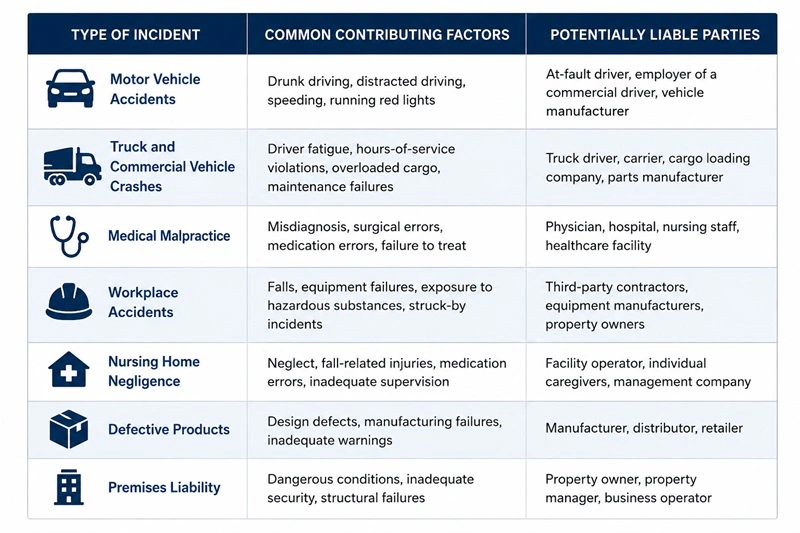
A civil wrongful death action can arise from many types of incidents. The common thread is that another party’s negligent or wrongful conduct caused the loss. Common causes include:
What the Case Must Establish
A wrongful death action is built on the same foundation as other personal injury cases. The personal representative must prove four elements on behalf of the surviving loved ones:

Duty of care. The defendant owed your loved one a legal duty. A driver owes a duty to other road users. A doctor owes a duty to their patient. A property owner owes a duty to lawful visitors.
Breach of duty. The defendant failed to meet that duty by acting negligently, recklessly, or wrongfully.
Causation. The breach of duty directly caused the fatal outcome. You must connect the defendant’s conduct to the loss.
Damages. Surviving loved ones suffered measurable losses as a result, including financial harm and non-economic suffering.
The standard of proof in a civil case is a preponderance of the evidence, meaning it is more likely than not that the defendant’s conduct caused the loss. This is lower than the criminal standard of proof. Our attorneys will review your situation and tell you honestly what the path forward looks like.
What Compensation Is Available?
The recoverable damages in these cases reflect what survivors have lost, not just what the deceased person suffered. They fall into two categories: damages through the main civil action and damages through a separate survival action. Both are typically filed together and pursued simultaneously.
Wrongful Death Action Damages

These are the losses experienced by surviving beneficiaries as a direct result of the fatal incident:
- Lost income and financial support the deceased would have provided over their expected working life
- Loss of the deceased’s guidance, care, and companionship
- The grief, mental anguish, and emotional suffering of those left behind
- Loss of the marital relationship and consortium for a surviving spouse
- Funeral and burial expenses
Survival Action Damages
A survival action is a separate civil filing by the estate. It recovers the losses the deceased person personally experienced between the time of the injury and the time of passing:
- Medical expenses incurred before passing
- Physical pain and suffering endured before passing
- Lost wages from the period of incapacity before passing
The total recovery from both actions can be substantial. Our wrongful death lawyers work with economic experts to calculate the full value of what surviving loved ones have lost. We have been recognized by Super Lawyers for legal skill and peer reputation, and we apply that same standard to every case we handle.
Can Punitive Damages Apply?
In cases involving especially egregious conduct, such as a drunk driver or a grossly negligent care facility, South Carolina courts may award punitive damages. These go beyond compensating for losses. They are designed to punish the defendant and deter similar conduct in the future. Punitive damages are not available in every matter, but our attorneys evaluate whether the facts support them from the very beginning of the representation.
Filing Deadlines You Need to Know

State law gives survivors three years from the date of the loved one’s passing to file a civil action, under S.C. Code § 15-3-530. This deadline is firm. If the case is not filed within three years, the right to pursue a recovery is lost in most circumstances.
There are important exceptions. If the incident involved a government entity or employee, the filing deadline may be as short as two years. Actions against the state or its agencies have additional procedural requirements, and missing those requirements can end a valid matter before it is ever heard.
Three years may sound like ample time. In practice, the earlier you engage an Abbeville wrongful death attorney, the stronger the case becomes. Witness memories fade. Surveillance footage gets overwritten. Physical evidence disappears. Records get lost. The investigation that supports a strong civil action is best started close in time to the incident.
Your Family Deserves a Full Accounting of Its Losses
A wrongful death can affect a family financially for years, from lost income and benefits to medical and funeral expenses. Talk with Hite Law Firm about what compensation may be available under South Carolina law.
Speak With Our AttorneysWhen the Fatal Incident Happened at Work
When a loved one dies in a workplace accident, workers’ compensation is generally the exclusive remedy against the employer. However, survivors are not limited to workers’ compensation if a third party contributed to the fatal incident. If a subcontractor, equipment manufacturer, property owner, or another driver was responsible, a separate civil action against that third party remains available alongside the workers’ comp filing.
Our attorneys evaluate every work-related fatal incident for third-party liability. The workers’ compensation system caps benefits. A third-party civil action is not capped the same way and can recover pain and suffering damages that workers’ compensation does not provide.
When a Serious Injury Becomes Fatal
Occasionally, our firm is already representing a client for a catastrophic injury when their condition becomes fatal. In those situations, we handle the transition from injury representation to a wrongful death action seamlessly so the family does not have to start over with a new attorney at the worst possible time. The investigation, evidence, and relationships our team has already built continue to serve the case.
For families dealing with a car accident that proved fatal, a trucking collision, a death caused by medical error, or neglect in a nursing home or care facility, the legal rights available to you go beyond filing a complaint. Our wrongful death attorneys pursue every avenue of recovery under South Carolina law.
Our Results for Abbeville Families

Hite Law Firm has secured significant results for survivors in and around Abbeville who have lost loved ones to the negligence of others. Our wrongful death cases have produced recoveries, including a $1.87 million settlement in a trucking accident fatal injury matter.
Past results do not guarantee a specific outcome in any individual matter. However, they reflect what is achievable when survivors have committed and experienced legal representation from the beginning of the process.
Reach Out to Our Wrongful Death Lawyers. We Are Here for You.
The attorneys at Hite Law Firm have handled fatal accident matters for more than 40 years. Our office has been located steps from the Abbeville County Courthouse on Court Square since 1981. We are not a referral service or a high-volume operation routing matters to attorneys you will never meet. When you reach out to us, you reach attorneys who are part of this community and who take these cases to heart.
You should not have to navigate this process alone, and you do not have to figure out your next step tonight. When you are ready, a conversation with our team costs you nothing and commits you to nothing. We handle wrongful death cases on a contingency fee basis: no fee unless we recover compensation on your behalf.
Talk With an Abbeville Wrongful Death Lawyer
Your family should have the space to grieve without also having to navigate insurers, evidence, and a legal claim alone. Contact Hite Law Firm for a free case review and let our team help you determine the next steps.
Speak With Our Attorneys