



Most people assume a driver is automatically at fault whenever a car strikes someone crossing the street. If a pedestrian is hit by a car, whose fault it is actually depends on several factors. Where the pedestrian was walking matters. So does whether the traffic signals were working, and what each party did in the seconds before impact. For anyone hurt in a crosswalk, understanding how liability gets assigned is just as important as understanding the injury itself.
Who Is At Fault When a Pedestrian Is Hit by a Car
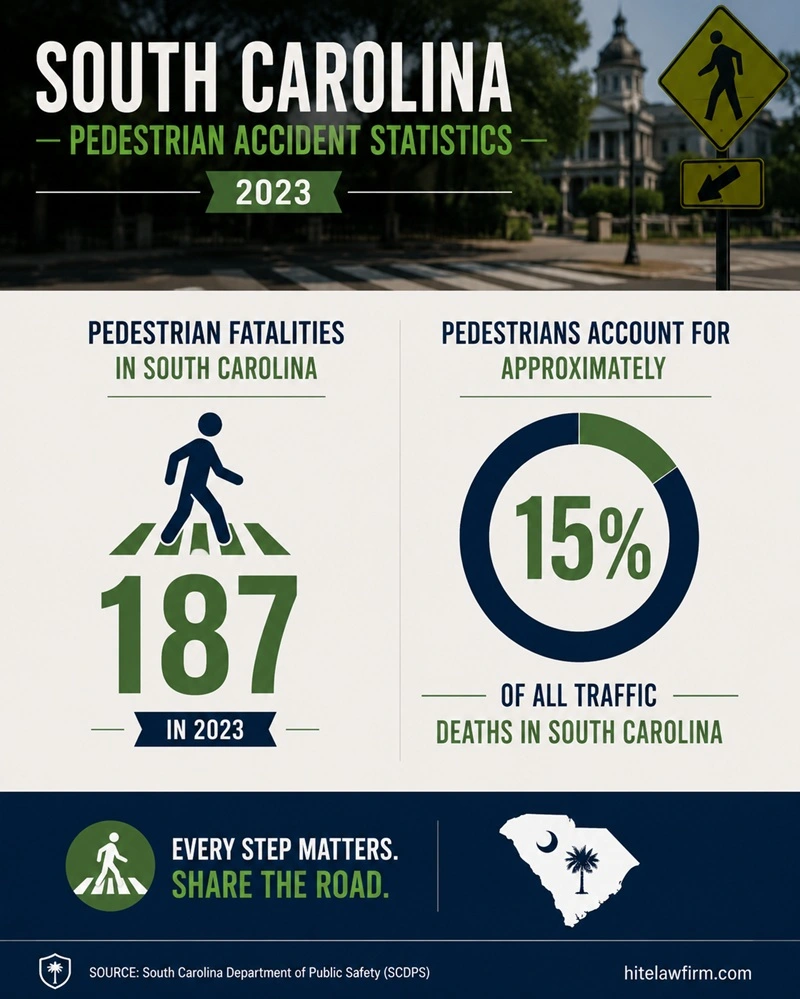
South Carolina law starts from a simple premise. Drivers owe pedestrians a duty of care. That duty exists whether or not a crosswalk is marked with paint. Under South Carolina Code Section 56-5-3130, a driver must yield to a pedestrian crossing within a crosswalk when traffic signals are not in place or not operating. That duty extends to unmarked crosswalks at intersections, not just the painted lines most people picture when they hear the word crosswalk.
Fault is not decided by a single rule, though. An investigator or insurance adjuster looks at the full picture. Where did the pedestrian enter the roadway? Was the driver distracted or speeding? What were the lighting conditions, and did either party violate a specific traffic law? A driver who runs a red light and strikes a pedestrian in a marked crosswalk is likely fully at fault. A pedestrian who steps off a curb into fast-moving traffic outside any crosswalk faces a very different set of facts.
What Makes a Driver At Fault in a Crosswalk Crash
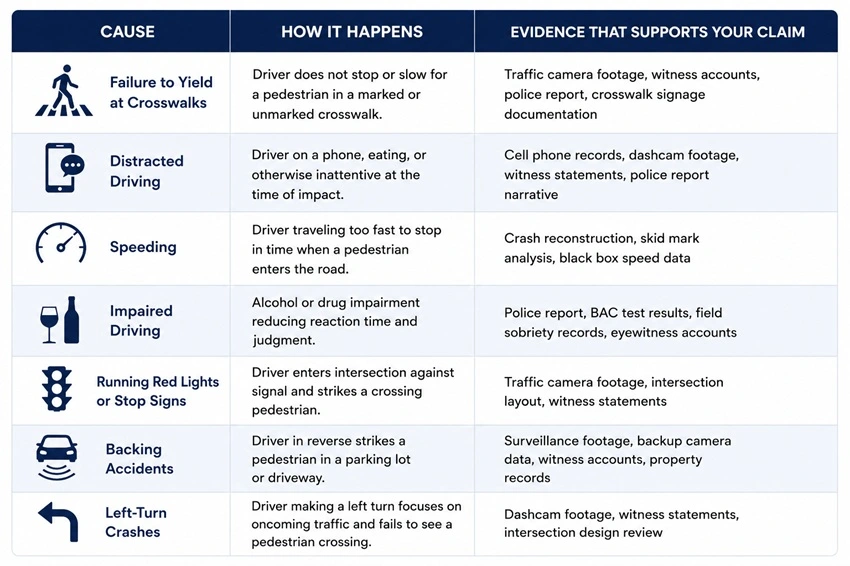
Certain driver behaviors show up again and again in claims involving a pedestrian injured by car traffic. Common examples include:
- Failing to yield when turning into a crosswalk where a pedestrian is lawfully present
- Distracted driving, including phone use, that delays a driver’s reaction time
- Speeding through school zones, parking lots, or residential streets where pedestrians are common
- Passing a vehicle that had already stopped to let someone cross
- Failing to see a pedestrian because of broken headlights or an obstructed view
- Not exercising extra caution around children near roadways, who South Carolina law recognizes as needing greater care from drivers
Insurance companies investigating these claims often pull traffic camera or storefront surveillance footage. Many businesses only retain that footage for a short window before it gets overwritten. Requesting preservation of that footage early can capture evidence that would otherwise disappear within days. This overlap between pedestrian claims and standard car accident claims is part of why fault investigations for both often rely on similar evidence.
When a Pedestrian Is Found Partially At Fault

Pedestrians can also carry some of the blame. South Carolina law requires people crossing outside of a marked or unmarked crosswalk to yield to vehicle traffic. Darting into the street mid-block can shift fault onto the pedestrian. So can ignoring a “Don’t Walk” signal or entering the road when a signal favors cross traffic. A pedestrian at fault car accident claim does not automatically fail in South Carolina. It does change how much compensation is available, though.
How South Carolina’s 51 Percent Rule Works
South Carolina follows a modified comparative negligence system, sometimes called the 51 percent bar rule. A pedestrian who is 50 percent or less at fault can still recover compensation. The award simply gets reduced by that percentage. A pedestrian found 51 percent or more at fault recovers nothing. Consider a jury that awards $200,000 in damages but finds the pedestrian 20 percent responsible for crossing mid-block. The recoverable amount drops to $160,000.
Few people realize that South Carolina’s crosswalk statute only requires a driver to yield when the pedestrian is on the driver’s half of the roadway. The same duty applies when the pedestrian is close enough to the opposite half to be in danger. A pedestrian who has already crossed to the far side of a wide road may carry more responsibility for a second vehicle’s approach than most claimants expect. This detail often surfaces during settlement negotiations and can catch an unrepresented claimant off guard.
Paying Medical Bills After a Pedestrian Accident
A fault investigation can take weeks, but medical bills don’t wait. South Carolina doesn’t require drivers to carry personal injury protection coverage. A pedestrian’s own health insurance typically pays for treatment first, with reimbursement addressed once liability is resolved. Keeping detailed records of every appointment, procedure, and bill during this period makes it easier to calculate the full value of a claim once fault is settled.
What Affects Pedestrian Injury Settlements
Once fault is established, the value of a claim depends on more than the percentage split. Pedestrian injury settlements typically account for economic losses like medical bills, lost wages, and future treatment. They also account for non-economic losses like pain, scarring, and lost enjoyment of daily life. Severity plays a role too. A pedestrian struck by a vehicle absorbs the full force of impact with no structural protection, which is why survivors often face injuries like traumatic brain injuries or spinal cord injuries that require lifelong care. That is part of why these injuries tend to be more severe than those from a typical car-to-car collision.
Nationally, 7,080 pedestrians died in traffic crashes in 2024, and 84 percent of those deaths happened in urban settings, according to NHTSA. Nearly three-quarters of pedestrian fatalities occurred at locations that were not intersections, compared with 18 percent at intersections. Alcohol use was reported in 43 percent of fatal pedestrian crashes that year, whether on the driver’s side, the pedestrian’s side, or both. When impairment involves the driver, the claim often overlaps with a broader drunk driving accident case. That pattern reflects how much pedestrian risk sits in areas without marked crossings or working signals, and those are also the locations where fault disputes tend to get the most complicated. When a crosswalk accident proves fatal, surviving family members may have grounds to pursue a separate wrongful death claim.
Anyone recovering from a crosswalk injury benefits from documentation gathered early. Photographs of the scene, witness contact information, and medical records that connect the injury to the crash all strengthen a claim. That kind of record is most valuable before an insurance company has a chance to dispute it. Working with a pedestrian accident lawyer during this stage can help preserve the evidence that fault investigations depend on.
Crosswalk Accidents and What Comes Next
Crosswalk accidents rarely come down to a single obvious cause. The circumstances of each case, from signal timing to exactly where a pedestrian stepped off the curb, shape how fault gets assigned. They also shape how much compensation ends up being available. That complexity is part of why insurance companies often push back hardest on pedestrian claims, knowing that shared fault rules can reduce or eliminate what they owe.
Recovering from an injury caused by a vehicle takes time, and the legal side of that recovery shouldn’t add unnecessary stress. Understanding South Carolina’s comparative negligence rules helps. So does understanding the specific duties drivers and pedestrians owe each other, and how quickly evidence can disappear. Together, these details give an injured pedestrian a clearer picture of what to expect from a claim.
For anyone navigating a hospital stay or a long recovery after being struck in a crosswalk, getting accurate answers early can shape the outcome of a case. Speaking with an attorney about the specific facts of a crosswalk accident is often the clearest way to understand what a claim may be worth.