



If a government employee causes a car accident in South Carolina, you may be able to pursue compensation for your injuries and other losses. However, claims involving government vehicles follow different rules than accidents involving private drivers.
The South Carolina Tort Claims Act allows injured individuals to bring certain negligence claims against state and local government agencies. It also establishes limits on compensation, filing deadlines, and circumstances in which government entities are protected from liability.
Whether you can pursue a claim depends on how the accident happened, whether the employee was performing job-related duties, and which legal protections apply.
A car accident attorney in South Carolina can help determine who may be responsible and what steps are necessary to pursue compensation.

Can You Sue a City or County for a Car Accident?
A city or county may be held responsible when an employee causes an accident through negligent driving while performing job-related duties.
For example, if a city maintenance worker runs a red light and strikes another vehicle while driving a government truck for work, the city may be liable for the resulting injuries and damages.
However, government responsibility is not automatic. The injured person must generally establish that the employee’s negligence caused their injuries and that no applicable legal exception protects the government agency from liability.
How the South Carolina Tort Claims Act Affects Liability
The South Carolina Tort Claims Act establishes when state and local government agencies can be held responsible for injuries caused by their employees. Although the law allows certain negligence claims, it also provides protections that do not typically apply to private drivers.
Sovereign Immunity and Its Exceptions
Sovereign immunity is a legal principle that generally protects government entities from being sued without their consent. South Carolina’s Tort Claims Act creates exceptions to that protection, allowing injured individuals to pursue certain claims against government agencies.
Under Section 15-78-40, government entities may be held liable for certain wrongful acts by their employees. However, Section 15-78-60 protects agencies from liability in specific circumstances, including certain government decisions involving judgment or discretion.
As a result, an injured person may not be able to recover compensation even when a government employee contributed to an accident.
When Is an Agency Responsible for Its Employee?
A government agency may be responsible when an employee negligently causes an accident while performing job-related duties.
For example, an employee driving between assigned work locations may be acting within the scope of employment. However, an employee using a government vehicle for an unauthorized personal trip may raise different liability questions.
Under Section 15-78-70, the government agency is generally the proper defendant when an employee causes an injury while acting within the scope of official duties. The injured person must still establish negligence, resulting harm, and that no applicable legal exception prevents recovery.
Accidents Involving Different Government Vehicles
The type of government vehicle involved and how it was being used can affect an accident claim.
Police Vehicles
Police vehicle accidents may occur during routine patrols, emergency responses, or pursuits. Different legal rules may apply depending on what the officer was doing when the collision occurred.
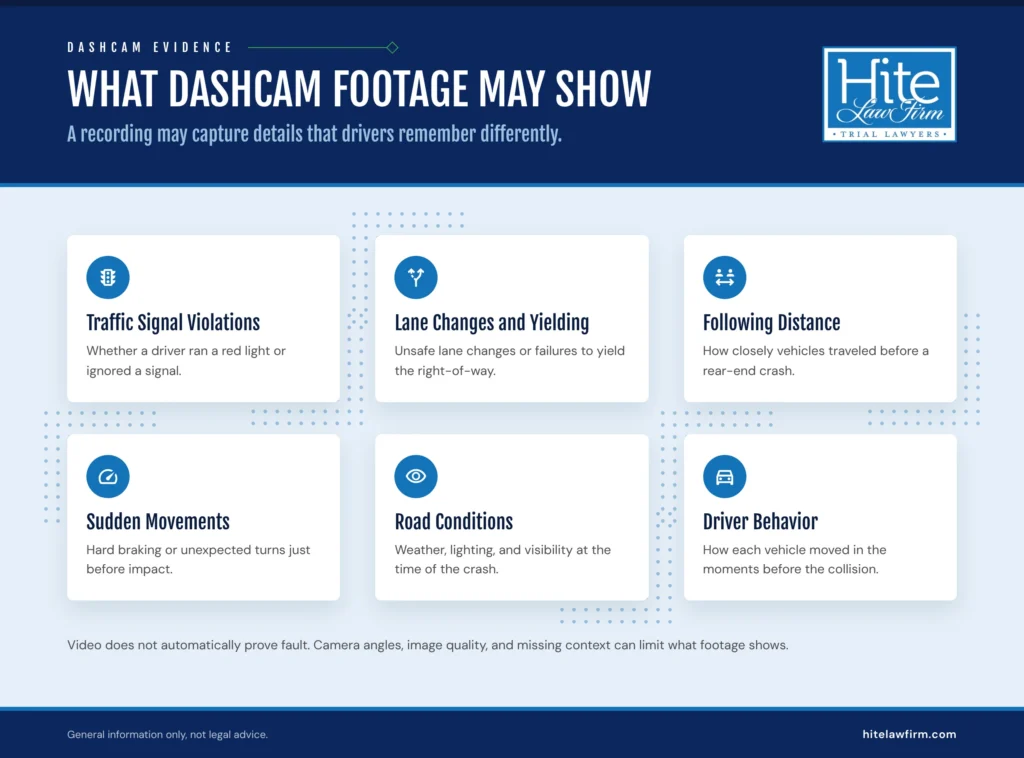
Evidence such as dashcam footage, dispatch records, vehicle speed, and emergency warning signals can help establish the circumstances.

School Buses
School bus accidents may involve public school districts or private transportation companies. Identifying who operated the bus is important because claims against private contractors may follow different rules than claims against government agencies.
Driver records, transportation contracts, and onboard recordings may help determine responsibility.
Municipal Trucks and State Agency Vehicles
City maintenance trucks, county utility vehicles, and state agency vehicles can cause accidents through distracted driving, failing to yield, unsafe lane changes, or other negligent actions.
Although these collisions may resemble ordinary car accidents, government agencies may still have legal protections that affect an injured person’s ability to recover compensation.
Are Emergency Vehicle Drivers Subject to Different Rules?
Under South Carolina Code Section 56-5-760, authorized emergency vehicle drivers have certain traffic privileges when responding to emergencies or pursuing suspected lawbreakers. These may include exceeding speed limits or proceeding through red lights after slowing as necessary for safe operation, provided the applicable legal requirements are met.
However, emergency vehicle drivers must still operate with due regard for the safety of others. Using emergency lights or sirens does not automatically protect a driver or government agency from liability.
Whether an emergency vehicle driver may be held responsible depends on the circumstances, including the vehicle’s speed, traffic conditions, warning signals, and reason for the emergency response. Police pursuits may involve additional legal protections that affect an injury claim.
What Compensation Is Available After a Government Vehicle Accident?
Someone injured by a government vehicle may be able to recover compensation for medical expenses, lost wages, property damage, pain and suffering, and other eligible losses.
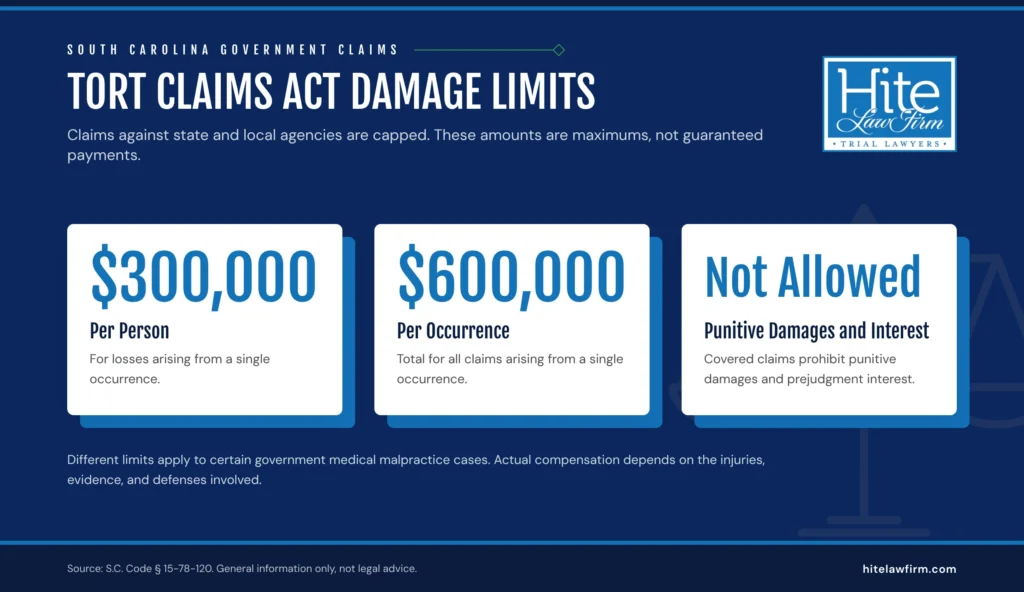
However, the South Carolina Tort Claims Act limits how much an injured person can recover from a government agency. Under Section 15-78-120, the statutory limits for ordinary covered claims are:
- $300,000 per person for losses arising from a single occurrence.
- $600,000 total for all claims arising from a single occurrence.
The Act also prohibits punitive damages and prejudgment interest in covered claims. Different limits apply to certain government medical malpractice cases.
These amounts are maximum limits, not guaranteed payments. Actual compensation depends on the injuries, available evidence, applicable defenses, and circumstances of the accident.
What Is the Filing Deadline for Government Accident Claims?
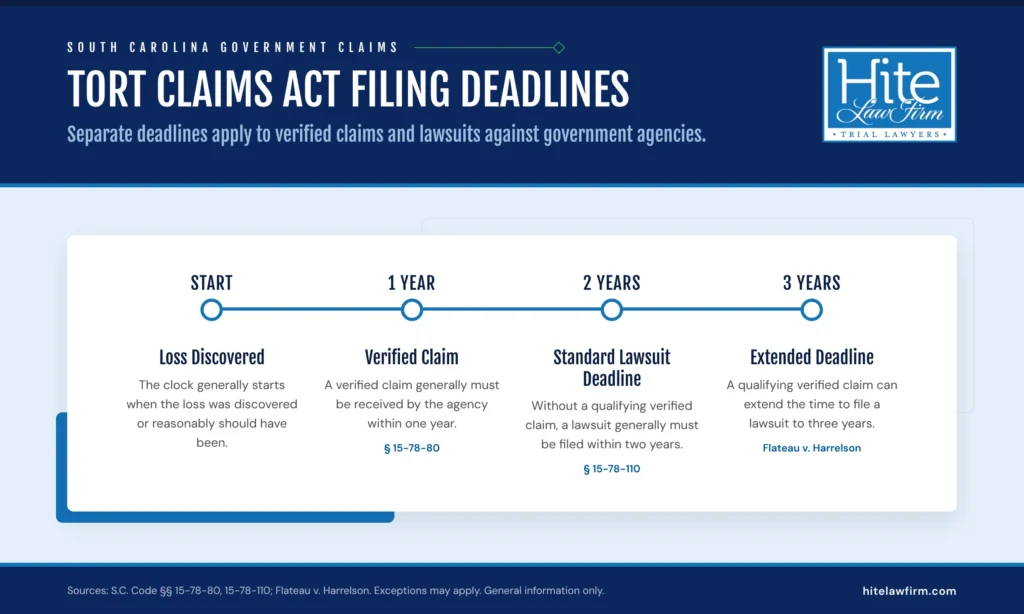
South Carolina generally gives injured individuals two years to file a lawsuit against a government agency under the Tort Claims Act. Under Section 15-78-110, this period typically begins when the loss was discovered or reasonably should have been discovered.
However, submitting a qualifying verified claim can extend the time allowed to file a lawsuit to three years.
How a Verified Claim Affects the Deadline
A verified claim is a formal written claim submitted to the appropriate government agency. Under Section 15-78-80, it generally must be received within one year after the loss was discovered or reasonably should have been discovered.
The claim includes information about the incident, the people involved, the injuries or losses, and the compensation requested.
Filing a verified claim is not required in every case. However, the South Carolina Court of Appeals explained in Flateau v. Harrelson that compliance with the verified-claim procedure is necessary to receive the benefit of the three-year filing period.
Without a qualifying verified claim, the standard two-year deadline generally applies, subject to applicable exceptions.
Because missing a filing deadline can prevent an injured person from pursuing compensation, identifying the applicable requirements early is important.
Why Identifying the Responsible Agency Matters
A government logo on a vehicle does not necessarily identify who is legally responsible for an accident. For example, a school bus may be operated by a private contractor, while a maintenance truck could belong to a city, county, or state agency.
Determining responsibility may require reviewing vehicle ownership, employment records, contracts, and the driver’s assigned duties. This information helps establish which organization may be liable, what legal protections apply, and where a claim should be submitted.
Identifying the responsible party early can also help ensure that important evidence is requested from the appropriate organization.
What Evidence Helps Establish Government Vehicle Liability?
Government vehicle accident claims may require records that are not typically involved in ordinary car accident cases.
Important evidence may include:
- Police crash reports and accident photographs
- Dashcam, surveillance, or onboard vehicle footage
- Witness statements
- Dispatch records and communications
- Vehicle speed and location data
- Driver employment and assignment records
- Vehicle maintenance records
- Medical records documenting injuries
This evidence can help establish how the collision occurred, whether the employee was performing job-related duties, and whether special emergency vehicle rules applied.
South Carolina Code Section 56-5-765 also establishes special investigation procedures for certain collisions involving law enforcement vehicles. Depending on the agency involved, an investigation may be conducted by the State Highway Patrol or another designated law enforcement authority.
Requesting relevant records promptly is important because electronic recordings and other evidence may be deleted or overwritten under routine retention policies.

What If a Federal Government Vehicle Caused the Accident?
Accidents involving federal government vehicles generally follow different rules than claims against South Carolina state or local agencies.
For example, a collision involving a U.S. Postal Service vehicle may fall under the Federal Tort Claims Act (FTCA). According to the U.S. Department of Justice, this law allows certain injury claims involving federal employees acting within the scope of their employment.
Unlike many ordinary car accident claims, the FTCA generally requires injured individuals to submit an administrative claim to the appropriate federal agency before filing a lawsuit.
According to the Department of Justice’s FTCA guidance, important deadlines include:
- Two years: An administrative claim generally must be presented to the appropriate federal agency within two years after the claim accrues.
- Six months: The agency generally has six months to make a final decision before the claimant may treat its failure to act as a denial and pursue a lawsuit.
- Six months after denial: If the agency issues a final written denial, the claimant generally has six months from the mailing of that denial to file a lawsuit.
Federal claims also involve separate legal protections and exceptions that can affect whether compensation is available.

Understanding Your Legal Options After a Government Vehicle Accident
An accident involving a government vehicle can raise questions that do not arise in an ordinary car accident claim. Determining who is responsible, whether government immunity applies, and which filing deadlines must be met can significantly affect an injured person’s options.
Hite Law Firm helps individuals and families in South Carolina understand their rights after vehicle accidents. Our firm’s car accident attorneys can investigate the circumstances of a collision, identify potentially responsible parties, and evaluate whether a claim for compensation may be available.
Not All Car Accidents Are The Same
If you were injured in an accident involving a government vehicle, contact Hite Law Firm to discuss your situation and the steps available to protect your claim.
Speak With Our Attorneys