



If you ride a motorcycle in South Carolina, you have probably thought about threading through slow traffic at some point. It can seem like a faster, safer alternative to sitting exposed between two stopped cars. But in South Carolina, lane splitting is illegal, and the consequences of doing it go beyond a traffic ticket. If you are involved in a crash while splitting lanes, that violation can directly affect your ability to recover compensation for your injuries.
Understanding the rules that apply to you as a rider, and what happens legally if those rules become part of a crash investigation, is something every motorcyclist in the state should know. If you have already been hurt in a crash and have questions about how traffic violations factor into your claim, our motorcycle accident attorneys are available for a free consultation.
Is Lane Splitting Legal in South Carolina?
No. Lane splitting is illegal in South Carolina under SC Code § 56-5-3640, which governs motorcycle operation on public roads.
This applies regardless of traffic conditions. Whether traffic is stopped, moving slowly, or flowing at highway speed, riding between lanes is prohibited. There is one exception: police officers performing official duties are not subject to this restriction.
As of 2025, South Carolina has no lane filtering law either. Lane filtering, which allows riders to move through stopped traffic at low speeds, is legal in a small number of states. South Carolina is not one of them. Any form of a motorcycle operating between lanes on a public road is a violation of state law.
Lane Splitting vs. Lane Sharing vs. Lane Filtering
These three terms are often used interchangeably, but they describe different behaviors. Understanding the distinction matters both for compliance and for evaluating a crash claim.
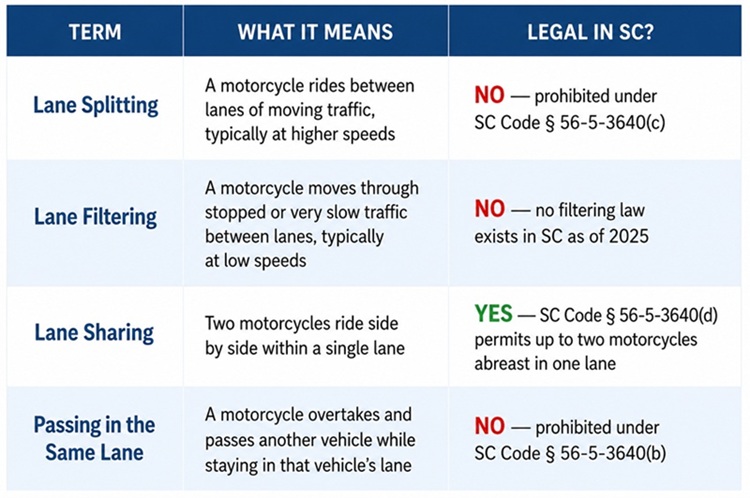
The practical upshot: two motorcycles can legally ride side by side within a single lane. A motorcycle cannot legally ride between a car and the lane line, between two cars in adjacent lanes, or pass a car without fully changing lanes.
Why South Carolina Prohibits Lane Splitting
The prohibition exists because of the specific dangers the practice creates in mixed traffic environments. When a motorcycle rides between lanes, it operates in spaces that other drivers are not monitoring for vehicle traffic. The risks compound quickly:
- Drivers making routine lane changes have no reason to check for a vehicle in the space between lanes
- Doors opening from parked or stopped vehicles can strike a passing rider with no warning
- A motorcycle between lanes has reduced escape room if a hazard appears suddenly
- Speed differentials between the motorcycle and stopped or slow traffic increase the severity of any contact
- Drivers in South Carolina are simply not accustomed to expecting motorcycles between lanes, unlike in states where the practice is legal
Proponents of lane splitting and filtering argue, with some research support, that these practices can reduce rear-end collisions and ease congestion. California, where lane splitting has long been practiced and was formally legalized in 2016, provides the most studied example. But South Carolina has not adopted those arguments into law, and riders here are bound by the current prohibition regardless of the safety debate.

South Carolina Motorcycle Lane Splitting Law and Your Crash Claim
Here is where the legal rule becomes personal for an injured rider. If you are involved in a crash and lane splitting is part of what happened, expect the other driver’s insurance company to use it against you.
South Carolina operates under a modified comparative negligence rule. If you are found to bear 51% or more of the fault for a crash, you cannot recover any compensation at all. Below that threshold, your recovery is reduced by your percentage of responsibility. A rider who was splitting lanes when a crash occurred may be assigned a significant share of fault, even if the other driver also did something wrong.
Fault Is Not Automatic
That said, a lane-splitting violation does not automatically destroy an injury claim. The relevant legal question is whether the violation was a proximate cause of the crash and the resulting harm. A rider who was splitting lanes in slow traffic and was then struck by a driver who ran a red light at an intersection may still have a viable claim. The lane splitting might affect the fault percentage, but the other driver’s independent negligence is still relevant.
Insurers will push to assign as much fault as possible to the motorcyclist. They will use the violation, photographs, traffic camera footage, and witness statements to build that case. An attorney who understands how SC comparative fault arguments work in motorcycle cases can evaluate how the violation affects your specific situation and what the realistic recovery looks like.
What If the Other Driver Was Entirely at Fault?
If the crash happened and lane splitting was not a contributing factor because the other driver was entirely responsible for the collision, regardless of where your motorcycle was positioned, a strong legal argument exists that the violation should carry minimal or no weight in the fault calculation. This is a fact-intensive analysis that depends on the specific mechanics of how the crash occurred. It is not something to navigate without legal guidance, particularly when serious injuries are involved.
If your injuries were severe, including spinal cord damage, traumatic brain injury, or other long-term harm, it is worth understanding that injuries in motorcycle crashes are among the most catastrophic in personal injury law, and the legal and financial strategy for those cases is different from a standard claim. When the crash resulted in a fatality, our wrongful death attorneys handle those cases throughout South Carolina.
South Carolina’s Motorcycle Safety Picture
Context matters when discussing any motorcycle law. South Carolina motorcycle accident laws exist against a backdrop of serious and persistent rider fatalities. South Carolina recorded 129 motorcycle deaths in 2024 and 140 in 2023. The state has ranked among the most dangerous in the nation for motorcyclists, with a fatality rate of 11.2 deaths per 10,000 registered motorcycle owners recorded in a recent study.
Secondary roads, the kind that wind through Abbeville County and the broader Upstate, account for the highest share of motorcycle injury crashes in the state. These roads have shorter sight lines, unpredictable surfaces, and less predictable traffic behavior than interstates. A rider who adds lane splitting to that risk profile compounds an already elevated danger.
Other Motorcycle Laws in South Carolina Riders Should Know
Lane splitting is one of several rules that riders sometimes misunderstand or overlook. A few others worth knowing:
Helmet Laws
South Carolina does not require helmets for riders 21 and older. Riders under 21 must wear a helmet. This is one of the more permissive helmet laws in the country, and it has consequences in injury cases. An insurer defending a head or brain injury claim will almost certainly argue that the rider’s decision not to wear a helmet contributed to the severity of the injury. This is a comparative fault argument that our attorneys address in every applicable case.
Lane Rights
SC Code § 56-5-3640(a) gives motorcycles the full use of a lane. No motor vehicle may be driven in a way that deprives a motorcycle of that full lane use. This provision protects riders from cars that crowd or squeeze into their lane, and it creates a legal basis for a negligence claim when a driver violates it. If another vehicle encroached on your lane before or during a crash, that violation matters.
Insurance Requirements
Motorcyclists must carry at least the state minimum liability coverage, which mirrors the general vehicle minimums: $25,000 per person and $50,000 per accident for bodily injury, plus $25,000 for property damage. Uninsured motorist coverage is also required and is especially relevant for motorcycle riders, who face a higher risk of serious injury from a crash with any at-fault driver, insured or not.
Eye Protection
Riders are required to wear eye protection unless their motorcycle has a windscreen. This is a commonly overlooked requirement and, like the helmet issue, can be used in a fault argument if eye protection was absent and visibility played a role in the crash.
What to Do After a Motorcycle Crash in South Carolina
If you were hurt in a crash, how you handle the aftermath matters significantly. Whether or not a traffic violation is involved, these steps protect your legal position.
- Call 911 and stay at the scene. A police report documents the facts and preserves the basic record. Note the officer’s observations about fault, road conditions, and any violations noted.
- Get medical attention right away. Motorcycle crashes frequently produce injuries that are not immediately apparent, including internal bleeding and brain trauma. In Abbeville, Self Regional Healthcare in nearby Greenwood and Abbeville Area Medical Center on Highway 72 are the primary care facilities for the area. Go immediately, and follow up as needed.
- Document everything you can. Photographs of the scene, the vehicles, road conditions, your gear, and your visible injuries all support your account. The position of the vehicles at rest is especially relevant in a case where lane position may become a disputed fact.
- Do not admit fault or apologize at the scene. Statements made at the scene become part of the record. Let the investigation establish the facts.
- Contact an attorney before speaking with any insurance company. The other driver’s insurer is not your advocate. Your own insurer, if a UM claim is involved, is also not your advocate in any adversarial sense. An attorney ensures your account of the crash is properly documented and that no statement is used against you.

How Hite Law Firm Helps Injured Riders in SC
Hite Law Firm has represented motorcycle crash victims throughout South Carolina, including in Abbeville, Greenwood, and across the Upstate and Lakelands region, for more than 40 years. Our attorneys understand how insurers approach motorcycle cases, how comparative fault arguments work in SC courts, and how to build a case that accounts for every relevant legal and factual issue, including traffic violations that may have occurred.
We handle motorcycle injury cases on a contingency basis. You pay nothing unless we recover compensation for you. If your crash raised serious injury or wrongful death issues, riders hurt by someone else’s negligence have more legal options than most people realize, and we handle the full range of those claims.
You do not have to figure out how a lane-splitting violation affects your case on your own. That is exactly what a free consultation is for.
Tell us what happened in your crash. We will give you an honest assessment of where things stand.