



A pool accident can change a family’s life in seconds. Whether it is a child who slips on a wet deck, an adult who hits an unmarked shallow end, or a drowning that happens during a moment of distraction, the aftermath raises an immediate and painful question: could this have been prevented, and is someone legally responsible?
The answer depends on the specific facts, but South Carolina’s premises liability law does establish clear duties for pool owners. When those duties are not met, and someone is hurt, the owner can be held accountable. If you or someone in your family was injured at a swimming pool in South Carolina, understanding who bears legal responsibility is the first step. Our premises liability attorneys are available for a free consultation to review what happened and what options exist.
Swimming Pool Accident Liability Under SC Law
Swimming pools fall under South Carolina’s premises liability law, which governs the duties property owners owe to people who enter their property. The standard that applies depends on the visitor’s legal status.
Most pool accident victims are either invitees or licensees. An invitee is someone invited onto the property for a business purpose or as a member of the public, such as a guest at a hotel pool, a patron at a community pool, or a customer at a commercial water facility. A licensee is a social guest invited onto private property, such as a neighbor or friend using a backyard pool. Property owners owe the highest duty of care to invitees. They must inspect regularly, fix known hazards, and warn about any dangers they know about or should know about. Licensees receive slightly less protection, but owners must still warn them about known hazards they would not reasonably discover on their own.

The Attractive Nuisance Doctrine
Swimming pools are the most litigated example of the attractive nuisance doctrine in premises liability law. Under this doctrine, property owners may be liable for injuries to children who trespass onto their property when the dangerous condition was likely to attract children who could not fully appreciate the risk.
A swimming pool is the type of structure courts have consistently recognized as an attractive nuisance. A child who wanders into a neighbor’s unfenced yard and drowns in an accessible pool is not simply a trespasser. The property owner who left the pool accessible may bear significant legal responsibility. South Carolina courts evaluate whether the owner knew children were likely to trespass, whether the risk of serious harm was substantial, and whether the burden of remediation was small relative to the danger.
This is why fencing matters so much legally. An owner who fails to secure a pool with a proper barrier, particularly when children are known to be in the neighborhood, faces meaningful exposure under the attractive nuisance doctrine even when no one had explicit permission to be on the property.
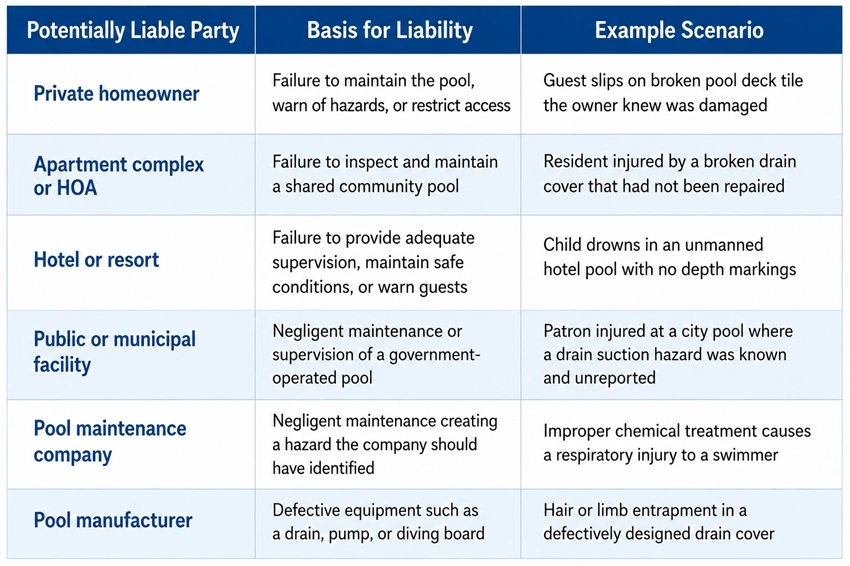
Who Can Be Held Liable for a Pool Accident?
Who is responsible for a swimming pool accident is rarely a simple question with a single answer. Depending on the circumstances, multiple parties may share legal responsibility.
Common Types of Pool Accidents in South Carolina
Pool accidents take many forms. The legal analysis for each depends on what specific duty was breached and whether the breach caused the harm.
Drowning and Near-Drowning
Drowning is the leading cause of death among children ages 1 to 4 in the United States. Over 4,500 people drowned each year nationally from 2020 to 2022, roughly 500 more per year than in 2019. In South Carolina specifically, children ages 1 to 4 had a drowning death rate of 2.7 per 100,000 population and a nonfatal drowning emergency department visit rate of 29.0 per 100,000 between 2018 and 2022.
Near-drowning survivors can face lasting brain damage from oxygen deprivation, even when they appear to recover physically. When a drowning occurs at a pool where adequate supervision, fencing, or safety equipment was absent, the owner’s failure to meet the applicable legal standard is the foundation of a claim.
Slip and Fall Injuries
Wet pool decks, inadequate drainage, broken tiles, and missing anti-slip surfacing are among the most common causes of pool-related injuries that do not involve the water itself. Slip and fall injuries at pools are treated as premises liability claims under the same legal framework that applies to any other commercial or residential property. The owner knew or should have known the deck was slippery and failed to address it.
Diving Injuries
Unmarked shallow water, missing or inadequate depth markings, and improperly positioned or maintained diving boards are common sources of catastrophic spinal cord injuries. When a diver strikes the pool bottom in water that was not marked as too shallow to dive, the owner’s failure to warn is a direct basis for liability.
Drain Entrapment
Pool and spa drains can create powerful suction forces capable of trapping hair, limbs, or the body of a swimmer against the drain cover. This hazard is well documented and has been the subject of federal legislation, the Virginia Graeme Baker Pool and Spa Safety Act, which requires anti-entrapment drain covers on public pools. When a pool is operating with a non-compliant or defective drain cover, the owner and any maintenance company servicing the pool may be liable for resulting injuries.
Chemical Injuries
Improper pool chemical maintenance can cause serious respiratory injuries, skin burns, and eye damage. A maintenance company that misapplied chemicals, or an owner who failed to test the water before allowing guests to swim, may bear liability when a swimmer is harmed.
What SC Pool Owners Are Required to Do
South Carolina law and local ordinances impose specific requirements on pool owners, particularly for residential pools. These requirements set the baseline standard of care. Violating them is strong evidence of negligence in a personal injury claim.
- Residential pools must be enclosed by a fence or barrier at least 48 inches high with a self-closing, self-latching gate.
- Public and commercial pools are subject to DHEC regulations covering water quality, drain design, depth markings, equipment condition, and in many cases, lifeguard requirements
- All pools covered by the VGB Act must use compliant anti-entrapment drain covers
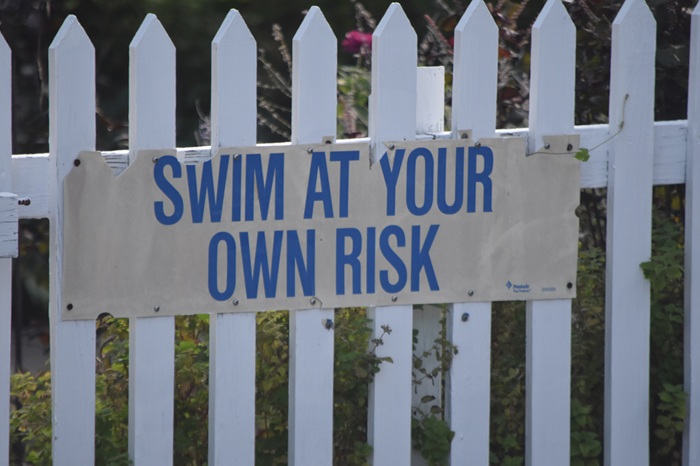
- Pool owners have a general duty to warn lawful visitors of known hazards that are not open and obvious
When an owner meets all applicable requirements, that compliance can be used in their defense. But compliance with minimum code requirements does not always defeat a negligence claim. A pool can meet code requirements and still be unreasonably dangerous if the owner was aware of a specific hazard and failed to address it.
The “Open and Obvious” Defense in Pool Cases
Property owners defending pool injury claims often argue that the danger was open and obvious, meaning a reasonable person would have noticed and avoided it. This defense comes up most often in diving injury cases, where an owner argues that shallow water is apparent from looking at the pool.
South Carolina courts do not treat this as an absolute defense. Even an obvious hazard can give rise to liability if the owner had reason to anticipate that visitors would nonetheless encounter it. A hotel pool with no depth markings at the shallow end, for example, may present an obvious risk to an adult who pauses to look, but a reasonable owner should anticipate that guests will enter the water without careful inspection, particularly when the pool layout is unfamiliar. An attorney evaluates whether the open and obvious defense has merit in each specific set of facts.

Comparative Fault in South Carolina Pool Cases
South Carolina follows a modified comparative negligence rule. If you are found to be 51% or more at fault for your own injury, you cannot recover anything. Below that threshold, your recovery is reduced by your percentage of responsibility.
Insurers defending pool injury claims routinely argue that the injured person was careless, failed to follow posted rules, was under the influence of alcohol, or assumed the risk of the activity. These arguments can be countered, but they affect the value of the claim and must be addressed directly in any negotiation or litigation. An attorney who handles pool accident premises liability claims builds the factual record that establishes the owner’s responsibility and limits the impact of comparative fault arguments.
Drowning Accident Lawsuits and Wrongful Death in South Carolina
When a pool accident results in a death, the legal framework shifts significantly. South Carolina law allows surviving family members to pursue a wrongful death claim against the responsible party. When a preventable drowning takes someone you love, a civil action can hold the property owner accountable and provide financial support for the family left behind.
The personal representative of the deceased’s estate files the wrongful death action. Recoverable damages include lost income and financial support, loss of companionship and guidance, grief and emotional suffering, and funeral expenses. A separate survival action may also recover losses the deceased experienced between the accident and their death, including medical expenses and pain and suffering.
Wrongful death claims arising from pool accidents have strict deadlines under South Carolina law. The standard statute of limitations is three years, but claims involving government-owned pools may have shorter deadlines and additional procedural requirements. Acting promptly protects the family’s legal rights.
What to Do After a Pool Accident in South Carolina
- Call 911 and get emergency medical care immediately. In the Abbeville area, Abbeville Area Medical Center on Highway 72 and Self Regional Healthcare in nearby Greenwood are the primary care facilities. For any drowning or near-drowning, even a brief loss of consciousness requires full emergency evaluation. Brain injury from oxygen deprivation can be present without obvious immediate symptoms.
- Do not move or clean the scene before documenting it. Photograph the pool, the deck, any warning signs or their absence, depth markings, fencing, and any hazard that contributed to the accident. This documentation is often difficult or impossible to recreate later.
- Report the incident to the property owner or manager and request a written incident report. Get a copy. Note who you spoke with and when.
- Preserve witness information. Anyone present who saw what happened can support the factual record. Names and contact numbers are enough.
- Seek legal advice before speaking with the property owner’s insurance carrier. Adjusters move quickly after serious pool accidents. Their job is to minimize the claim. Speak with an attorney before giving any recorded statement.

How Hite Law Firm Approaches Pool Accident Claims in SC
The personal injury lawyers at Hite Law Firm have represented people hurt on dangerous property throughout South Carolina for more than 40 years. Pool accident cases require immediate investigation. Pool conditions change, maintenance records disappear, and video footage is overwritten quickly. Our attorneys act fast to preserve the evidence that builds a strong claim.
We handle swimming pool injury and premises liability cases on a contingency basis.