



Not every workplace injury results from a sudden accident. Repeated lifting, gripping, reaching, or other physical movements can gradually damage muscles, tendons, nerves, and joints. Workers may experience symptoms for weeks or months before recognizing that their job duties could be contributing to an injury.
South Carolina workers’ compensation law recognizes qualifying repetitive trauma injuries. However, receiving workers’ compensation benefits requires evidence connecting the medical condition to repetitive workplace activities.
Understanding how these claims work can help employees recognize symptoms, meet important deadlines, and document their injuries.
What Is a Repetitive Motion Injury?
Under S.C. Code § 42-1-172, a repetitive trauma injury develops gradually from the cumulative effects of repeated traumatic events.

Unlike an injury caused by a single accident, repetitive trauma may develop through regular workplace activities over an extended period.
Examples include:
- Repeated lifting, pushing, or pulling
- Frequent bending, reaching, or twisting
- Continuous gripping or use of hand tools
- Assembly-line movements
- Repeated stocking or scanning of products
- Prolonged keyboard and mouse use
- Working in awkward positions
These activities do not automatically establish a compensable injury. South Carolina requires evidence that repetitive work contributed directly to the diagnosed condition.
Common Types of Repetitive Stress Injuries
Repetitive workplace movements can affect several parts of the body, depending on the tasks performed and the physical demands involved.
Carpal tunnel syndrome is a common example. It occurs when the median nerve becomes compressed at the wrist, potentially causing pain, numbness, tingling, or weakness in the hand.
Other conditions may include tendinitis, shoulder injuries, elbow problems, and certain back or neck conditions associated with repetitive physical activity.

Symptoms can develop gradually and may include:
- Persistent pain or aching
- Numbness or tingling
- Muscle weakness
- Joint stiffness or swelling
- Reduced grip strength
- Limited range of motion
Early symptoms may appear only during work and improve with rest. As the condition progresses, discomfort may become more frequent or interfere with everyday activities.
Persistent symptoms should be medically evaluated to identify the underlying condition and determine whether workplace activities may be contributing.
Can You Receive Workers’ Compensation Without a Single Accident?

Yes. South Carolina law allows qualifying repetitive trauma injuries to be considered for workers’ compensation even when no specific accident caused the condition.
However, S.C. Code § 42-1-172 requires a causal connection between repetitive employment activities and the injury, established through qualifying medical evidence.
In Brooks v. Benore Logistics System, Inc. (2024), the South Carolina Supreme Court clarified that repetitive trauma claims require proof that the employee’s work was repetitive and that the repetitive activities caused the injury. Medical causation must be established under the statutory requirements.
For example, an employee who develops shoulder pain after years of overhead lifting must establish more than the existence of pain. The evidence must support a connection between the diagnosed injury and the employee’s repetitive work activities.
This distinction is important because similar medical conditions can develop from occupational and non-occupational causes.
How Medical Evidence Supports a Repetitive Trauma Claim
Medical evidence plays a central role in determining whether a repetitive injury qualifies for workers’ compensation.

A qualified physician may evaluate the worker’s diagnosis, medical history, physical symptoms, and job responsibilities to determine whether a direct causal relationship exists.
Detailed descriptions of workplace activities can help explain the physical demands involved.
For example, describing a job simply as warehouse work provides limited information. Explaining that an employee repeatedly lifts heavy products from floor-level pallets for several hours each shift gives a clearer picture of the physical exposure.
Relevant medical documentation may include diagnostic testing, examination findings, treatment records, and physician opinions addressing the relationship between work and the injury.
The evidence must meet South Carolina’s legal standard rather than relying solely on the employee’s belief that work caused the condition.
When Should You Report a Repetitive Injury?
South Carolina has specific reporting requirements for repetitive trauma injuries.
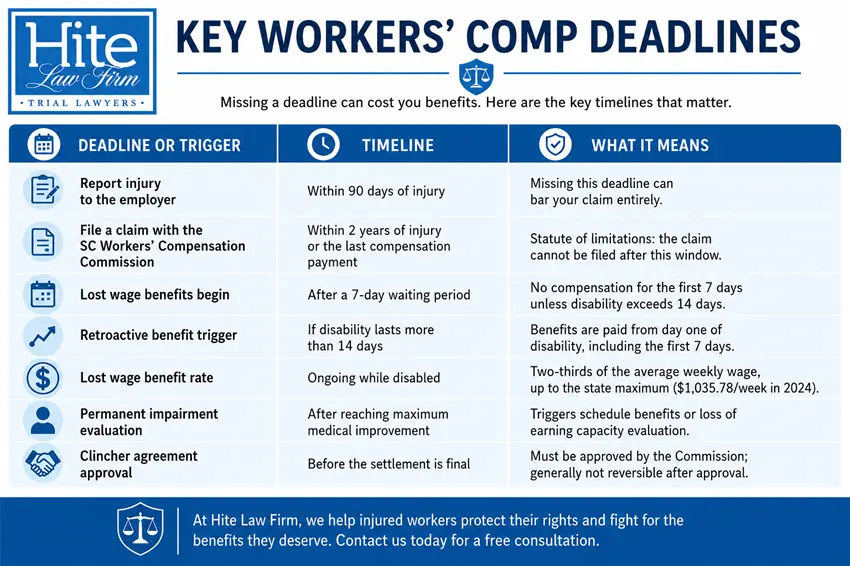
Under S.C. Code § 42-15-20, an employee generally must notify the employer within 90 days after discovering, or when reasonable diligence would have revealed, that the condition is compensable.
Because repetitive injuries develop gradually, identifying when the reporting period begins can be more complicated than with sudden workplace accidents.
Employees should report suspected work-related conditions promptly rather than waiting for symptoms to become severe.
A written report should accurately describe the symptoms, affected body parts, and work activities believed to be involved.
The law recognizes certain exceptions involving reasonable excuses and lack of undue prejudice to the employer, but timely reporting remains the safer approach.

How Long Do You Have to File a Workers’ Compensation Claim?
Reporting an injury to an employer is different from formally filing a workers’ compensation claim.
Under S.C. Code § 42-15-40, repetitive trauma claims generally must be filed with the South Carolina Workers’ Compensation Commission within two years after the employee knew or should have known the injury was compensable.
The statute also establishes an outside limit of seven years after the last injurious exposure.
These deadlines are particularly important because workers may continue performing repetitive tasks while symptoms gradually worsen.
Employees should not assume that a gradual injury allows unlimited time to pursue benefits.
For additional information about the claims process, see this guide to filing a workers’ compensation claim in South Carolina.
What Evidence Can Help Support Your Claim?
Beyond medical documentation, workplace records can help establish the nature and frequency of repetitive activities.

Useful evidence may include:
- Detailed job descriptions and regular duties
- Work schedules and overtime records
- Production quotas or task requirements
- Records of tools and equipment used
- Workplace injury reports
- Communications about symptoms
- Coworker statements describing job activities
- Records showing changes in responsibilities
For example, production records may help demonstrate how frequently an assembly worker performs the same movement during a shift.
Together, these materials can provide context for the medical evaluation and help clarify whether the employee’s regular duties involved repetitive physical exposure.
What Workers’ Compensation Benefits Are Available?
Workers with qualifying repetitive trauma injuries may receive several types of benefits under South Carolina law.
Medical Benefits
Authorized medical treatment may include physician visits, diagnostic testing, medication, physical therapy, and other medically necessary services related to the compensable injury.
Treatment depends on the diagnosed condition and the worker’s medical needs.
Temporary Disability Benefits

Employees who cannot work because of a compensable injury may qualify for wage-replacement benefits.
Temporary total disability benefits are generally calculated at 66⅔% of the employee’s average weekly wage, subject to statutory limits and eligibility requirements.
For injuries occurring in 2026, the South Carolina Workers’ Compensation Commission lists a maximum weekly compensation rate of $1,189.94.
Permanent Disability Benefits
Permanent disability benefits may apply when an employee experiences lasting impairment after reaching maximum medical improvement.
The amount and type of compensation depend on the injury, applicable legal provisions, and medical findings.
Unlike personal injury lawsuits, workers’ compensation generally does not provide separate damages for pain and suffering.
Why Are Repetitive Trauma Claims Sometimes Denied?

Repetitive trauma claims may be disputed because the injury developed gradually rather than during a clearly identifiable accident.
Common disputes involve whether the employee’s work activities were sufficiently repetitive, whether those activities caused the diagnosed condition, or whether another medical issue contributed to the symptoms.
Employers or insurers may also question whether reporting and filing deadlines were satisfied.
A preexisting medical condition does not automatically eliminate the possibility of compensation, but it may make the medical causation analysis more complicated.
Accurate medical records, detailed job information, and timely reporting can help address these issues.
When to Get Legal Guidance In a Workers’ Comp Claim
Repetitive motion injuries can interfere with an employee’s ability to work, particularly when symptoms worsen despite rest or treatment.
Legal guidance may be useful when an employer disputes the injury, an insurance company denies benefits, or questions arise about medical evidence and filing deadlines.
A South Carolina workers’ compensation lawyer can review job duties, medical documentation, and the circumstances surrounding the claim to help determine whether the injury meets state requirements.
If repetitive workplace activities have contributed to a diagnosed injury, Hite Law Firm can review your situation, explain the workers’ compensation process, and help you understand your available legal options.
Work-Related Pain May Qualify for Compensation.
Repetitive injuries can affect your ability to work, even without a single identifiable accident. Hite Law Firm helps injured South Carolina workers evaluate medical evidence, navigate disputed claims, and pursue available benefits.
Reach Out Today